 Sarasota Window
 Siding Built for What Laurel Park Actually Deals With
Laurel Park sits close enough to the Gulf that its homes take a different kind of beating than siding was designed for decades ago. Between hurricane-force wind events, some of the most intense year-round UV exposure in the country, wind-driven rain that finds every gap in a wall assembly, and salt-laden air that never really lets up, exterior materials here age faster than the same products would in almost any other part of the country. Siding that performs fine in a mild inland climate can start failing within a few years on a Sarasota County home if it wasn't engineered — or installed — for this environment.
That's the entire reason we standardized on James Hardie fiber cement and stopped installing anything else. This page is about what that means specifically for a Laurel Park home: what the climate demands, what a correct installation actually involves, and how our process works from first look to final walk-through.
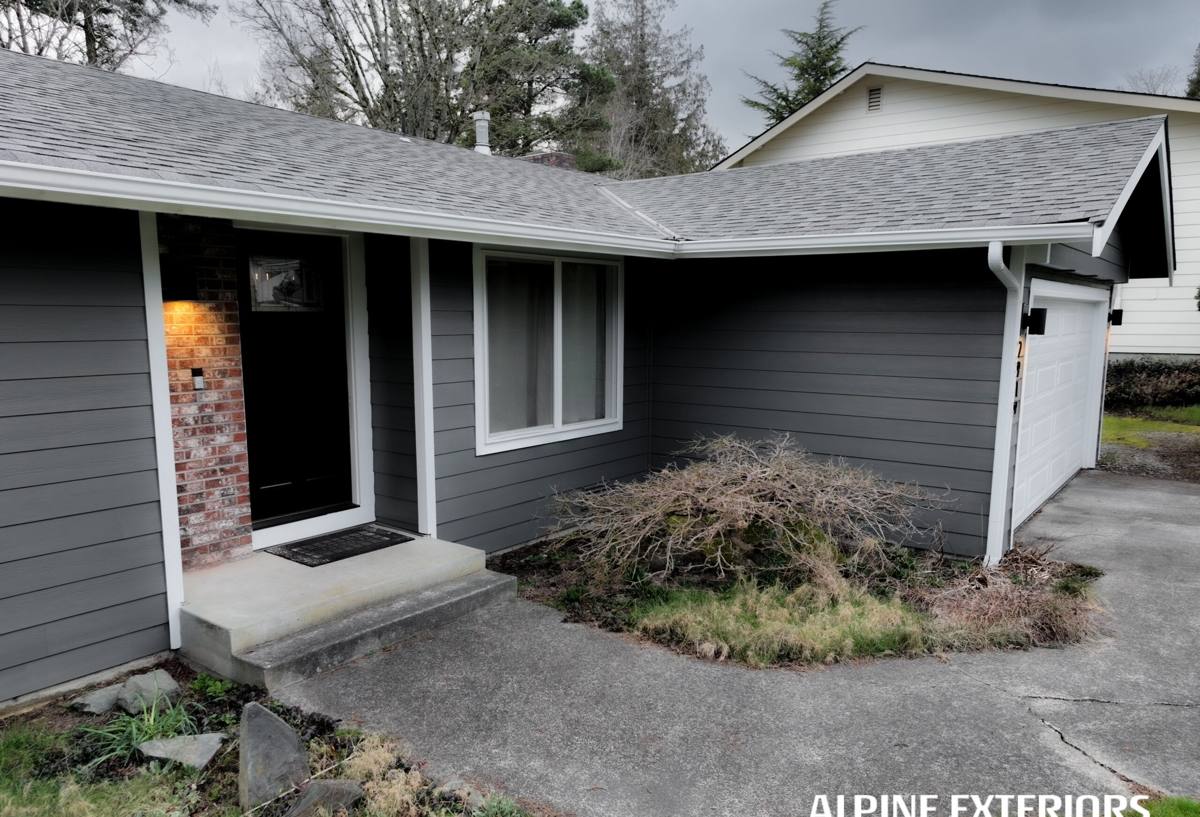
What Sarasota's Climate Does to a Home's Exterior
Wind Load
Homes in this part of Florida are built to withstand serious sustained wind and gusts well beyond that during tropical systems. Siding isn't just cosmetic here — it's part of the building envelope. Panels that aren't fastened to spec, or that use the wrong fastener spacing for the wind zone, can lift, crack, or pull away entirely in a storm. This is one of the most common failure points we see on homes that were sided by out-of-area crews unfamiliar with local wind requirements.
UV Exposure
Year-round sun breaks down pigments and surface coatings faster here than almost anywhere else in the continental U.S. Paint-grade materials chalk, fade, and need repainting on a shortened cycle. This is a big part of why factory-applied, baked-on finishes matter so much in this market — a finish applied under controlled conditions holds color dramatically longer than anything brushed or sprayed on-site.
Wind-Driven Rain and Moisture
Storms here don't just drop rain straight down — wind pushes it sideways, up under laps, and into any seam that isn't properly flashed and sealed. Materials that absorb and hold moisture are vulnerable to swelling, soft spots, and rot, especially at butt joints, corners, and penetrations where water naturally collects.
Salt Air
Even at a few miles inland, salt in the air accelerates corrosion of fasteners and metal trim, and it can be harder on certain coatings and adhesives than fresh-water climates. Material and hardware choices that ignore this tend to show their age early — streaking, corrosion bleed, and finish breakdown around fastener heads.
Why We Only Install James Hardie
James Hardie fiber cement is engineered specifically to resist the combination of moisture, UV, and impact that Gulf Coast homes deal with. It's non-combustible, dimensionally stable in humidity swings, and available in HZ product lines formulated for specific climate zones — Laurel Park falls into the HZ10 zone, meaning the material itself is formulated for hot, humid, moisture-heavy conditions rather than a generic national spec.
The ColorPlus factory finish is a major part of the value here. It's baked on in a controlled facility with a finish warranty backing it, which matters enormously in a climate that's this hard on paint. We won't install vinyl, LP SmartSide, Cemplank, Allura, or primed wood siding — not because those products have no merit anywhere, but because for what Sarasota County homes are exposed to, we don't think they hold up as well over the long run as correctly installed Hardie, and we'd rather stand behind one system we trust completely than offer several we have reservations about.
Signs a Laurel Park Home Needs New Siding
- Soft or spongy spots when you press on the siding, especially near the bottom courses or around windows
- Visible cracking, warping, or buckling panels
- Paint that's chalking heavily or peeling in sheets rather than wearing evenly
- Gaps opening up at seams, corners, or trim after storm seasons
- Rust streaks bleeding from fastener heads or trim
- Rising cooling bills that suggest the wall assembly behind the siding is compromised
- Visible mold, mildew, or staining that keeps coming back after cleaning
Any one of these can be minor. Several together usually mean the siding system — not just the surface — is failing and a patch job won't hold for long.
What a Correct Installation Actually Involves
Prep and Moisture Management
The siding is only as good as what's behind it. That means a proper weather-resistive barrier, correctly lapped and taped seams, and flashing at every window, door, and penetration so water is directed out and away from the wall — not trapped behind the cladding where it can't dry out.
Fastening to Wind Zone
Fastener type, spacing, and placement have to match the local wind requirements, not a generic national default. This is where we see the most corner-cutting from crews who don't regularly work this coastline — using standard spacing instead of the tighter pattern our wind exposure actually calls for.
Clearances and Joints
Hardie siding needs specific clearance from grade, roofing, decks, and other trim to keep water from wicking up into the material. Butt joints need to be properly sealed or backed with flashing, not just butted and caulked, since caulk alone degrades under this level of UV and won't hold up as the sole moisture defense.
Cutting and Finishing
Cut edges expose raw fiber cement that needs to be sealed to match the factory finish's moisture resistance. Skipping this step is a common shortcut that leads to premature failure right at the cuts — usually around windows, corners, and trim where the most cutting happens.
Comparing What Laurel Park Homeowners Are Often Choosing Between
| Factor | James Hardie Fiber Cement | Vinyl | Wood / LP SmartSide |
|---|---|---|---|
| Wind performance | Engineered and rated for high wind zones | Can crack or blow off in high gusts | Adequate if fastened correctly, but panel integrity depends on moisture condition |
| UV / fade resistance | Factory finish with long color warranty | Fades and can warp from heat | Paint-grade, needs repainting on a shorter cycle |
| Moisture behavior | Dimensionally stable, engineered for humidity | Doesn't rot, but traps moisture behind it if installed poorly | Engineered wood can swell or degrade if moisture gets in |
| Fire resistance | Non-combustible | Combustible | Combustible |
| Salt air durability | Formulated for coastal exposure (HZ10) | Generally stable but coatings can degrade | More vulnerable to moisture-driven decay near coast |
This isn't a knock on every alternative product across every climate — it's specifically why, for homes taking this much sun, wind, and salt, we think fiber cement engineered for the zone is the more defensible long-term choice.
What Drives Cost on a Laurel Park Project
| Factor | Why It Matters |
|---|---|
| Home size and wall complexity | More corners, gables, and dormers mean more cutting, flashing, and labor time |
| Current siding removal | Tear-off and disposal of failing material adds time versus a clean substrate |
| Substrate condition | Rotted sheathing or framing discovered underneath needs repair before new siding goes on |
| Product line and profile | Lap width, panel style, and trim details affect material cost |
| ColorPlus vs. field-painted | Factory finish costs more upfront but avoids repainting cycles later |
| Access and site conditions | Fencing, landscaping, and setback affect staging and scaffolding needs |
We won't throw out a number without seeing the home — every one of these factors changes the estimate, and giving a ballpark before inspecting the walls and substrate underneath does homeowners a disservice.
Why a Crew That Already Works Laurel Park Matters
Fiber cement installation quality varies enormously by crew, and the details that matter most in this climate — fastener spacing for wind zone, flashing details for wind-driven rain, clearances that account for humidity and salt exposure — are exactly the details a generalist crew from outside the area is most likely to shortcut. A crew that regularly works Sarasota County neighborhoods knows the wind requirements, knows what moisture damage looks like on homes in this exposure, and isn't guessing at spec.
There's also a practical side: local crews are positioned to respond quickly if something needs attention after a storm, and they have a reputation in the community that outside crews passing through don't have to protect.
Our Process
- Inspection — we look at the current siding, substrate, and any moisture or storm damage, not just the surface appearance
- Assessment and estimate — a written scope covering removal, substrate repair if needed, product line, and finish
- Prep — weather-resistive barrier, flashing at all penetrations, and substrate repair completed before any siding goes up
- Installation — fastened to local wind-zone spec, with proper clearances and sealed cut edges
- Final walk-through — we go over the finished work with the homeowner before calling the job complete
Maintaining Hardie Siding in a Coastal Climate
- Rinse the exterior periodically to clear salt residue and airborne debris
- Keep sprinklers and irrigation from hitting the siding directly and constantly
- Inspect caulking at joints and trim annually, especially after storm season
- Trim landscaping back from the siding to allow airflow and drying
- Address any soft spots, cracks, or paint failure early rather than waiting
Even engineered materials need basic upkeep — the difference is that Hardie, installed correctly, gives a Laurel Park home a much longer runway before that upkeep becomes a repair.
If you're weighing a siding replacement in Laurel Park, we're glad to come take a look, walk you through what we see, and put together a straightforward, no-pressure estimate — just fill out the form below.